

One is the whole thing; the other is a single component of it, about the size of a fist, that sat on top of a helmet.
The distinction is worth ten minutes because it is the fastest way to tell a source that knows the subject from one that does not — and because the two are used for different things even today.
The Achievement: the Whole Assembly
The correct technical term for a complete coat of arms is an achievement. Not every achievement has every part; most have only a few.
- The shield, or escutcheon. The only indispensable element. When a herald says "the arms", this is what they mean — the field, its divisions, and the charges on it. Everything else is an accessory.
- The helmet, or helm. Sits directly on the shield. In British practice its metal and position signal rank: gold and full-faced for a sovereign, silver with gold bars for a peer, steel in profile with the visor closed for an untitled gentleman.
- The torse, or wreath. A twisted band of silk, conventionally drawn in six twists alternating the principal metal and colour of the arms. It exists to hide the join where the crest was lashed to the helmet.
- The crest. The figure standing on the torse. See below — this is the one everybody misnames.
- The mantling. Cloth hanging from the helmet, drawn slashed and curling. It represents the fabric worn over a helm in the sun, and the slashing represents sword damage.
- Supporters. Figures flanking the shield. In England and Scotland these are tightly restricted — peers, certain knights, and corporate bodies — so a family shield with supporters is a strong sign the image was assembled by a printer rather than a herald.
- The compartment. Whatever the supporters are standing on: a grassy mound, a bar, a bracket.
- The motto. On a scroll below the shield in England, above the crest in Scotland.
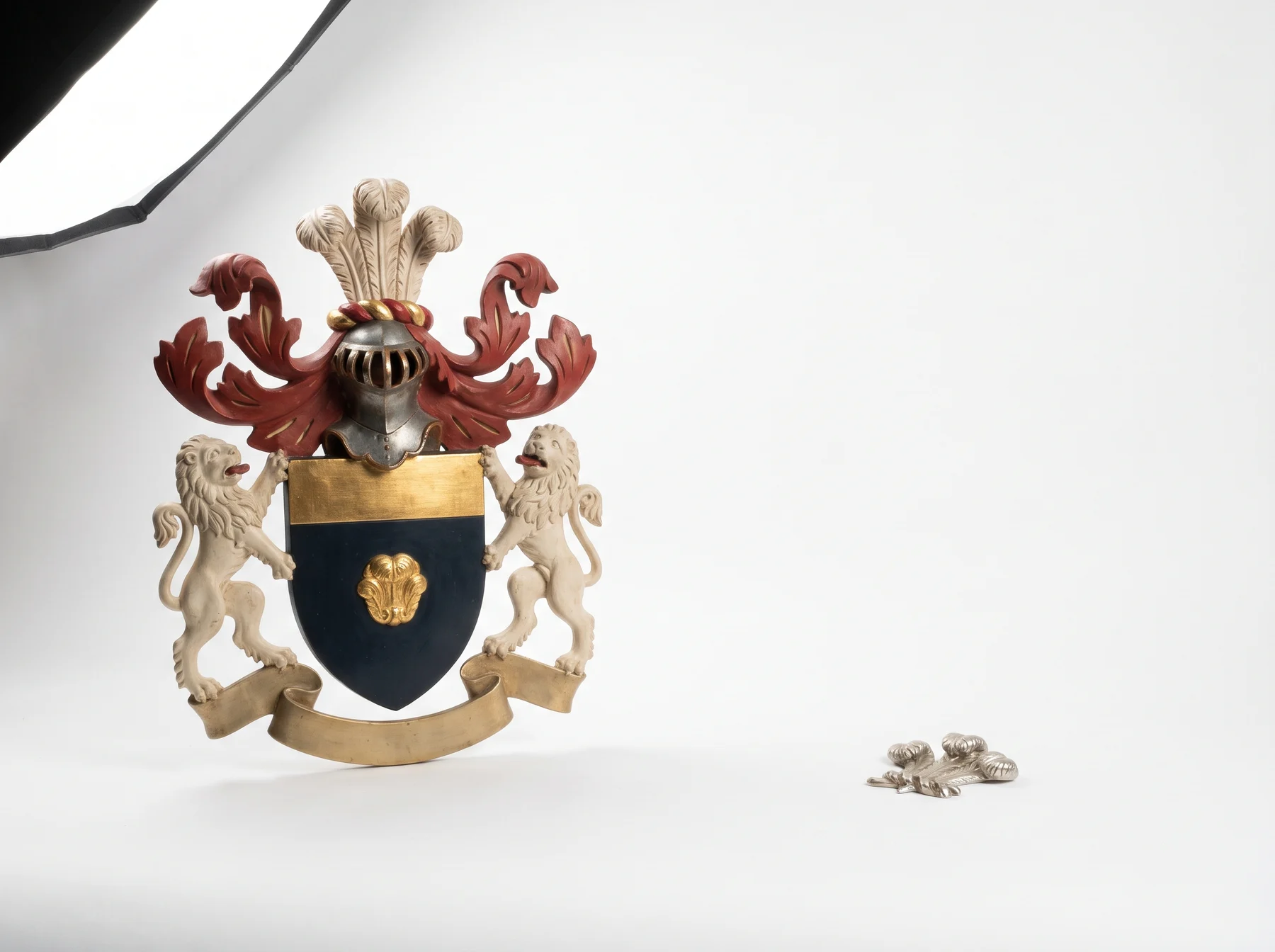
The Crest: One Object, on Top of a Helmet
The crest is the figure fixed to the top of the helm, and it started as a physical object. Crests were built in boiled leather, light wood, parchment stiffened with glue, or moulded cloth, and they were genuinely worn — first in tournaments, later mostly in funeral processions and effigies. Some surviving examples are enormous: the crest of the Black Prince, still hanging in Canterbury Cathedral, is a leather lion the size of a small dog.
Three facts follow, and each one has a practical consequence.
A crest is granted separately from arms. Plenty of families have arms and no crest at all. If a source shows you a crest for every surname it lists, it is generating images rather than reporting records.
A crest is never borne alone by its owner in formal use. It sits on the helm, on the shield. Displayed on its own it is a badge — a shorthand.
That shorthand is why the word drifted. A shield with eight charges will not engrave onto a signet ring the size of a fingernail, and it will not stamp legibly into wax. A crest will. So from the seventeenth century onwards the crest went onto seals, rings, silver, carriage doors, bookplates and writing paper, while the full achievement stayed on the wall. The part people saw every day became the part they named the whole thing after.
Two words that are not interchangeable
The shield itself
- What the blazon describes
- Present in every grant
- Stands on its own
- Ever worn on a helmet
The figure above the helm
- Granted separately
- Rises from a wreath or coronet
- Present in every coat of arms
- The whole achievement, strictly
Is "Family Crest" Wrong?
In ordinary speech, no. It is now the common usage, everyone understands it, and correcting people at dinner is not a heraldic duty.
It matters in exactly one situation: when you are trying to establish what actually exists. Ask for "our family crest" and you may be shown a full achievement, a bare shield, or a lion on a wreath with nothing under it. Ask for "the blazon of the arms" and the answer is either a precise description or an admission that there isn't one. The second question is the one that gets a checkable answer.
How the System Came About
Heraldry appears in the twelfth century, and it appears because armour got better. Once the face was covered by a great helm, a man in the field was anonymous. Painting a distinctive device on the shield — and repeating it on the linen surcoat worn over mail, the coat of arms — solved the problem.
Two things then turned a battlefield convention into a legal system. First, the devices became hereditary: by the early thirteenth century sons were bearing their fathers' arms, with small alterations to distinguish them. Second, the men employed to memorise and announce them — the heralds — became officials with authority over who could bear what, and gave the whole system their name.
The crest arrives a little later, with the tournament, for a reason that is pure practicality: a shield is held low and side-on, and from across a lists a three-dimensional figure standing above the crowd is far easier to identify.
The Other Terms You Will Meet
- Badge. Older than the crest and separate from it. A badge is a device worn by a lord's followers and servants — Richard III's white boar, the Percy crescent. It is not part of the achievement and is not restricted the same way.
- Blazon. The formal written description of the arms. The blazon is the authoritative version; a painting is one artist's reading of it. Two drawings of the same blazon can look very different and both be right.
- Armiger. A person entitled to bear arms.
- Achievement. The whole assembly, as above. The word has nothing to do with accomplishment — it comes from the French achèvement, a completion.
- Crest badge. A Scottish item specifically: the chief's crest inside a strap and buckle, worn by clan members. It belongs to the clan system, not to the wearer.
Which One Do You Want?
It depends entirely on the surface.
For a wall, a bookplate or a certificate, you want the full achievement — shield, helm, torse, crest, mantling and motto. At that size every element reads, and the composition was designed for it.
For anything small and anything that has to survive being pressed into wax — a signet ring, a seal, a monogram on a case — you want the crest alone, or the shield alone if the arms are simple. This is not a compromise. It is the original and correct use of a crest, and it is how they were used for four hundred years.
Finding Out What Exists for Your Name
One point to be straight about: arms belonged to individuals and descended to their heirs, not to everyone sharing a surname. What an armorial records is the arms borne by particular families, in particular places, at particular dates. That is a real and specific thing — and it is a different thing from a certificate saying a design belongs to you.
The Heritage Volume sets out what the historical record holds for a surname: the arms associated with it, blazoned properly, alongside the origin of the name itself. How Your Report Is Made explains exactly how it is put together.
Displaying It
- A framed coat of arms — the full achievement, at a size where every element reads.
- A signet ring — the crest, used the way crests were meant to be used.
- A women's signet ring — the same, in a narrower band.
- The Heirloom — the arms and the written history of the name together.


