

It is also, for the most part, an invention of the seventeenth century.
That does not mean the symbols are meaningless. It means they mean something else — something more specific, more checkable, and considerably more interesting than a list of virtues. This guide separates the two.
What a Charge Actually Is
Anything placed on the shield is a charge. Heralds divide them into two families.
The ordinaries are the simple geometric bands that came first, and they came first for a reason: they are what you get when you reinforce a wooden shield with strips of metal. A fess is a horizontal band across the middle. A pale is a vertical one. A bend runs diagonally, a chevron is an inverted V, a saltire is a diagonal cross, a cross is an upright one. These are structural shapes before they are symbols.
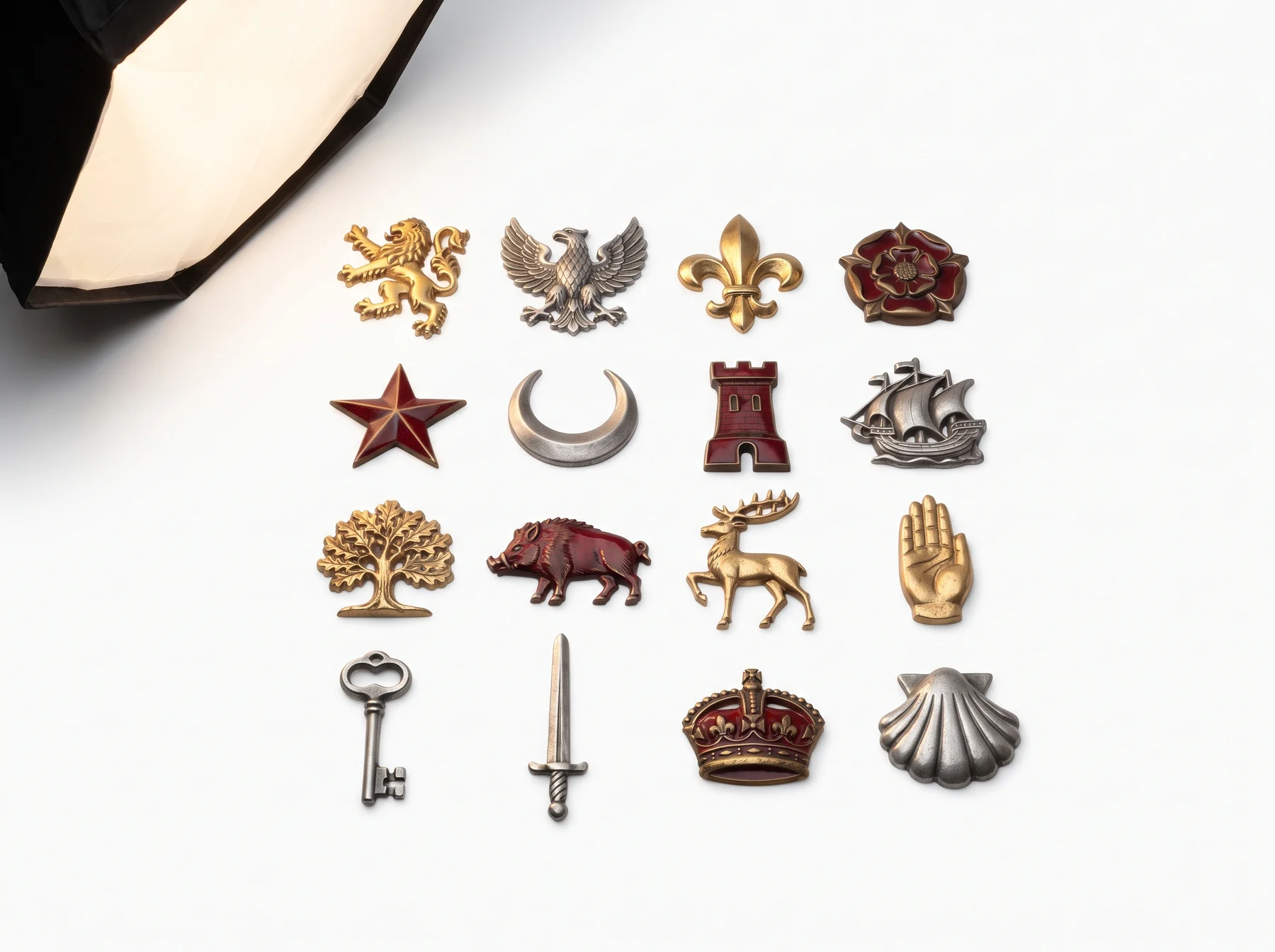
Everything else — beasts, birds, plants, buildings, tools, monsters — is an ordinary charge, and this is where the real information sits.
The Three Real Reasons a Charge Is on a Shield
1. It puns on the name
This is the single most common reason, and once you see it you cannot stop seeing it. Heralds call it canting.
The Shelley family bore whelk shells. The Lucy family bore luces, the medieval word for pike. The Corbet family bore a raven, from the French corbeau. The Trumpington family bore trumpets. The Bowes family bore bows. The Salmon family bore salmon. At the level of kingdoms: Castile bore a castle, and León a lion.
So when you look at a shield and see a recognisable object, the first question a herald asks is not "what virtue does this represent" but "does this sound like the name".
2. It records a relationship
Arms are combined when families are. Marshalling is the practice of placing two or more coats on one shield to show a marriage, an inheritance or a claim. Quarterly — the shield divided into four — is the standard form, and each quarter is a real family that married into the line. A shield with sixteen quarterings is a pedigree, drawn.
Borrowed charges work the same way. A family that held land from a great magnate often took an element of his arms into its own, as a visible statement of whose man it was.
3. It was granted for something specific
An augmentation of honour is an element added to existing arms by the sovereign to commemorate a particular act or event. These are documented, dated, and attached to a named person. When an augmentation appears on a shield, there is a record behind it.
The Symbols That Do Carry Documented Meaning
A real body of heraldic symbolism exists. It is religious, dynastic and national — not moral.
Religious
- The pelican in her piety — a pelican wounding her own breast to feed her young — is a medieval Christian emblem of Christ's sacrifice, used with that meaning for centuries. This one is genuine symbolism, not Jacobean invention.
- The cross exists in dozens of documented variants — patriarchal, potent, moline, fleury, botonny — and the variant is often the identifying feature, not a message.
- The escallop (scallop shell) is the badge of the pilgrimage to Santiago de Compostela.
Dynastic and national
- The lion rampant within a double tressure flory counter-flory is the royal arms of Scotland, and in Scotland its use is restricted by law.
- The double-headed eagle belongs to the imperial tradition — the Holy Roman Empire, and later Austria and Russia. The single eagle is widespread in German and Polish arms.
- The fleur-de-lis is the emblem of the French crown.
- The red rose and the white rose are the badges of Lancaster and York; the combined Tudor rose is the settlement of that quarrel made visible.
- The thistle for Scotland, the shamrock for Ireland, the harp as the arms of Ireland, the red dragon for Wales.
- The unicorn is a supporter of the royal arms of Scotland — which is why it stands beside the lion in the arms of the United Kingdom.
The Vocabulary Worth Learning: Attitude
How a beast is posed is part of its identity, and it is precise. Two families may both bear a lion and bear entirely different arms.
- Rampant — rearing on one hind leg, the classic pose.
- Passant — walking, one forepaw raised. Three lions passant guardant are the arms of England.
- Statant — standing on all four.
- Sejant — seated. Couchant — lying down. Salient — leaping.
- Guardant — head turned to face the viewer. Regardant — looking back over its shoulder.
Birds have their own: an eagle displayed has its wings spread; a bird close has them folded; rising means about to take flight.
Where the List of Virtues Came From
From books, and they can be dated.
Beginning in the late sixteenth century, heraldic writers developed a fashion for assigning moral qualities to charges and tinctures, usually alongside planets, gemstones and the ages of man. The most influential English example is John Guillim's A Display of Heraldrie (1611), reprinted for a century and the direct ancestor of every symbol-meaning table circulating today.
Working heralds treated it as ornament rather than doctrine, and by the modern era they were blunt about it. A. C. Fox-Davies, whose A Complete Guide to Heraldry (1909) remains the standard English reference, called the symbolism of colours "absolutely and entirely fiction" and was scarcely kinder about charges. No grant of arms has ever been justified by what an animal is supposed to signify.
The practical consequence: if a shield in your family bears a wolf, it does not tell you an ancestor was rewarded for perseverance in a long siege. It may well tell you the family name sounded like wolf.
How to Read a Shield, in Order
- The field — its tincture, or how it is divided.
- The principal charge — what it is, its tincture, and its attitude.
- Secondary charges, and where they sit.
- Marks of difference — small additions distinguishing one branch from another.
Then ask the three questions that actually produce answers: does the charge pun on the name, does it look borrowed from another family's arms, and is it the kind of element that gets granted rather than assumed.
Reading Your Family's Coat of Arms
The charges on a coat of arms are a record of decisions — a pun a herald enjoyed, a marriage that brought land, a service the crown chose to commemorate. Read that way, they are documents. Read as a horoscope of ancestral virtues, they stop being about your family at all and become a table from 1611.
The Heritage Volume names and blazons the charges on the arms associated with your surname, in the order above, and says what each one is. What it will not do is tell you that the lion proves your ancestors were brave. Our full method is set out in How Your Report Is Made.
See the charges at full resolution with a framed coat of arms, or carry the crest on a signet ring.


