

Once you know the grammar, a shield stops being an ornament and becomes something you can read, compare and check.
This guide takes you through it in the order a herald would: the achievement, then the shield, then the blazon that describes it.
The Anatomy of a Full Achievement
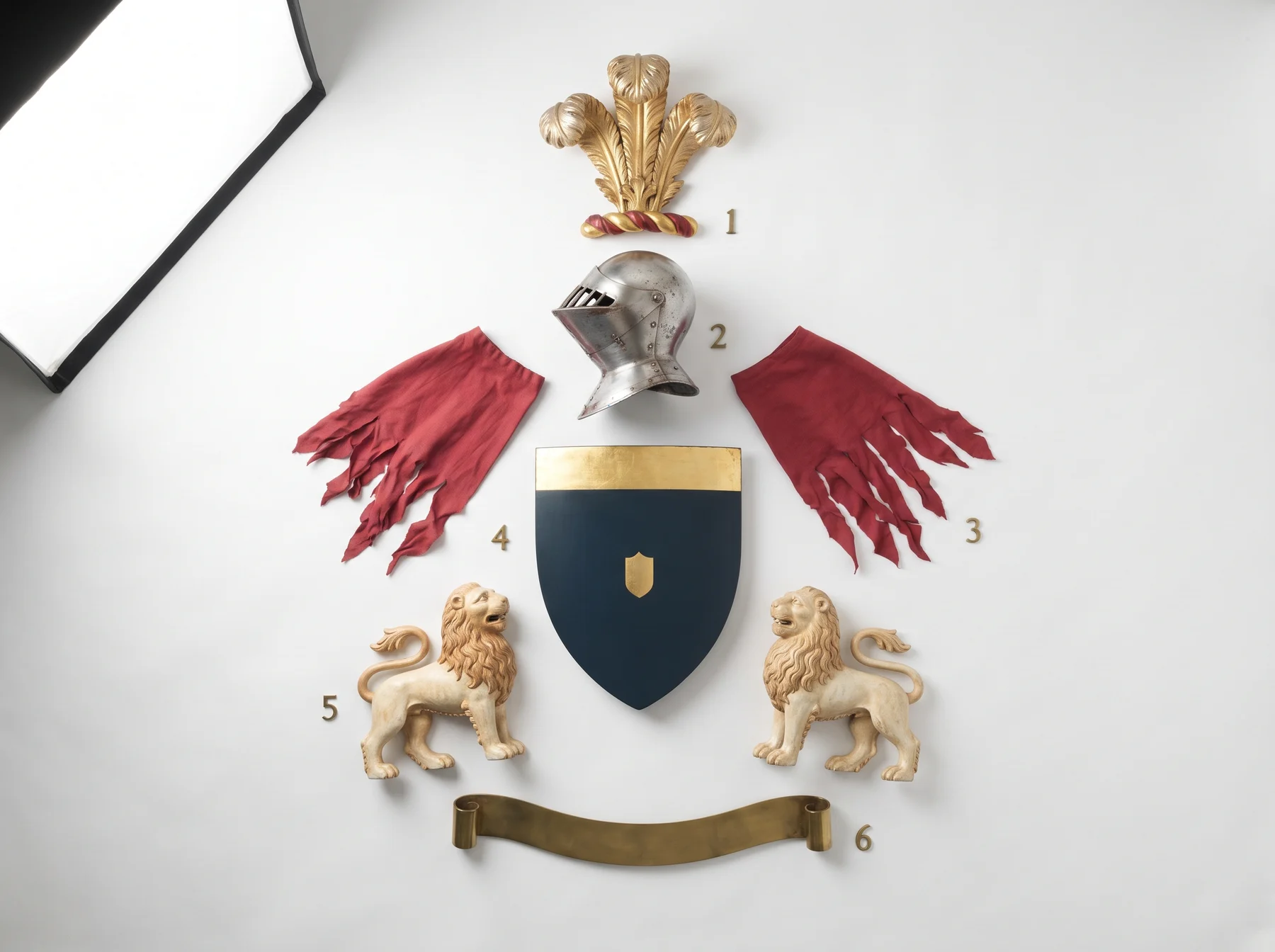
The technical term for the whole assembly is an achievement. Most families never had all of its parts, and much of what circulates as "your coat of arms" is a shield with a helmet and crest added by a nineteenth-century engraver. The parts, from the ground up:
- The shield (escutcheon) — the only indispensable element. Everything else is optional; this is the arms.
- The helmet (helm) — its type and position indicate rank in some traditions. In British practice a sovereign's helm is gold and full-faced, a peer's is silver with gold bars, an ordinary gentleman's is steel, in profile, visor closed.
- The wreath (torse) — a twisted band, conventionally six twists of the principal metal and colour, between helmet and crest.
- The crest — the figure on top of the helmet. It is not the coat of arms, and this is the most common confusion in the whole subject.
- The mantling — cloth falling from the helmet, slashed into scrollwork. It represents the cloth worn over a helm against sun and rain.
- Supporters — figures flanking the shield. In England and Scotland these are strictly controlled and belong to peers, certain knights, and corporate bodies. A family shield with supporters on a gift-shop print is almost always an invention.
- The compartment — whatever the supporters stand on.
- The motto — on a scroll, below the shield in English practice and above the crest in Scottish practice.
First, Orient Yourself: Dexter and Sinister
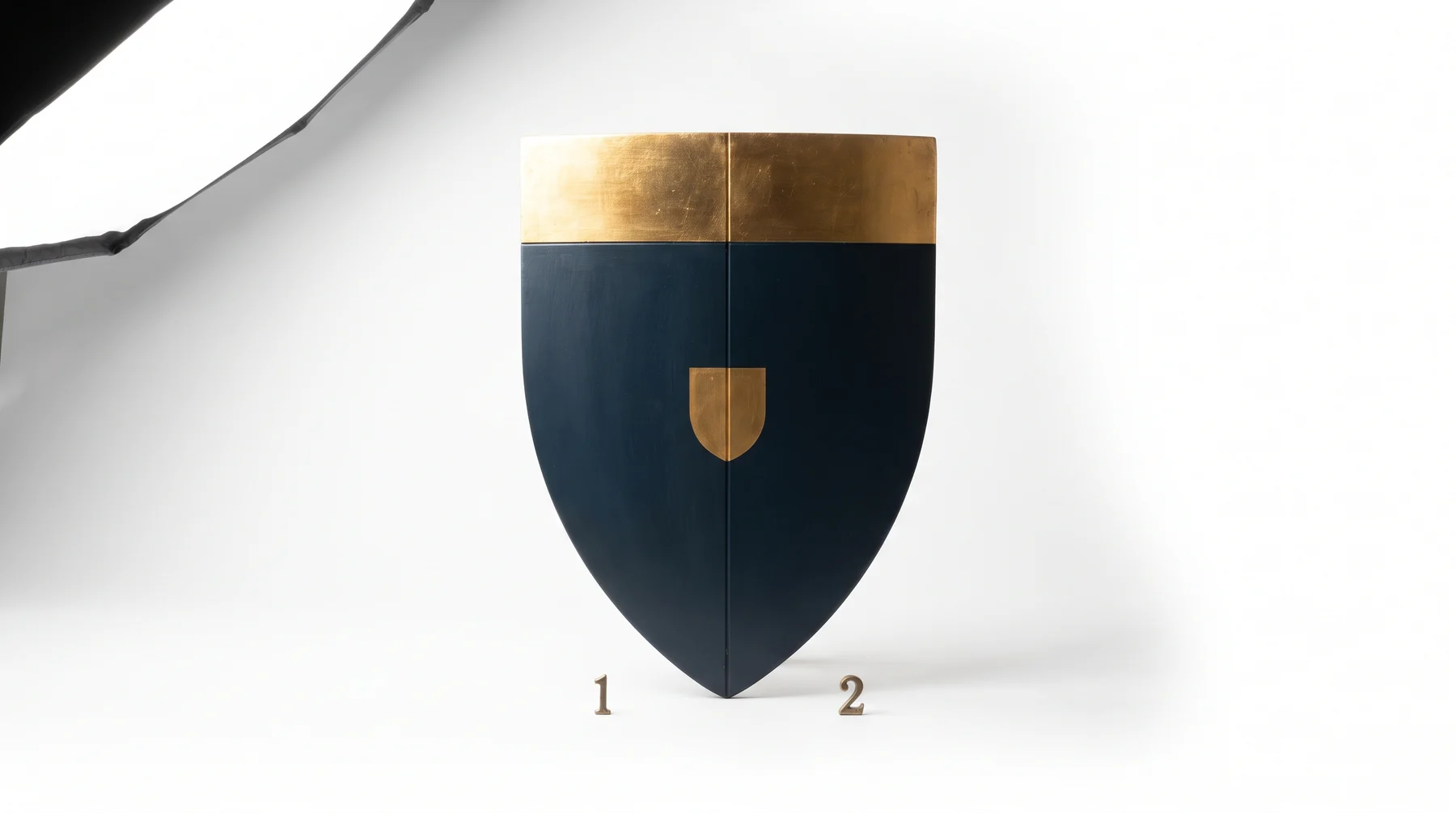
Before anything else: heraldic left and right are given from the point of view of the person carrying the shield, not the person looking at it. Dexter is the bearer's right, which is your left as you face it. Sinister is the bearer's left, your right.
Dexter is the senior side. When two coats are placed side by side after a marriage, the husband's arms go in dexter; when a beast faces "forward", it faces to dexter. Get this backwards and you will misread every combined shield you meet.
Reading the Shield, Step by Step
Step 1: The field
The field is the surface of the shield. It has a tincture, and it may be divided.
The metals are Or (gold, drawn yellow) and Argent (silver, drawn white). The colours are Gules (red), Azure (blue), Sable (black), Vert (green) and Purpure (purple). The furs — ermine, vair and their variants — stand outside both groups.
The field may also be divided rather than plain: per pale (split vertically), per fess (horizontally), per bend (diagonally), quarterly (into four), per chevron, per saltire. A divided field is described by its division first, then its tinctures in order.
The rule of tincture: colour is not placed on colour, nor metal on metal. A red lion goes on gold or silver, never on blue. The reason is legibility at distance, and it is the closest thing heraldry has to a law of physics. Deliberate breaches exist and have a name — armes à enquérir, arms to be enquired into — and the most famous is the Kingdom of Jerusalem: gold crosses on silver.
Step 2: The ordinaries
The ordinaries are the broad geometric bands, and they are the oldest charges in heraldry because they descend from the structural reinforcement of a real shield.
- Chief — a band across the top third.
- Fess — a horizontal band across the middle.
- Pale — a vertical band down the centre.
- Bend — diagonal from dexter chief to sinister base. A bend sinister runs the other way.
- Chevron — an inverted V.
- Cross and saltire — upright and diagonal crosses.
- Bordure — a border around the edge, often a mark of difference rather than a design choice.
- Pile, canton, quarter — a wedge, a small corner square, a large one.
Each has diminutives: a narrow pale is a pallet, a narrow bend a bendlet, a narrow fess a bar. And edges can be patterned — engrailed, invected, indented, wavy, embattled, nebuly, dancetty — which is frequently the only thing distinguishing one family's arms from another's.
Step 3: The charges
Everything else placed on the field is a charge: beasts, birds, monsters, plants, buildings, tools, celestial bodies, human figures and parts of them.
The question to ask about a charge is not "what virtue does it stand for" — that table is a seventeenth-century literary invention — but why is it here. Three answers cover most cases: it puns on the family name (heralds call this canting, and it is extremely common), it was borrowed from the arms of a family the bearer was tied to, or it was granted for a specific recorded reason.
Step 4: The attitude
How a beast is posed is part of its identity, not a drawing choice. Two families may both bear a lion and bear entirely different arms.
- Rampant — rearing on one hind leg. Unless stated otherwise it faces dexter, which is your left.
- Passant — walking, one forepaw raised.
- Statant — standing on all fours. Sejant — sitting. Couchant — lying down. Salient — leaping. Dormant — asleep.
- Guardant — head turned out towards you. Regardant — looking back over the shoulder. These combine: the three beasts of England are lions passant guardant.
- For birds: displayed (wings spread), close (folded), rising (about to fly), volant (in flight).
Step 5: Marks of difference
Two men could not bear identical arms. Within one family, junior branches added small marks — in English practice the label for the eldest son during his father's lifetime, the crescent for the second, the mullet for the third, and so on down a fixed list. In Scotland the same job is done by the bordure, and it is done under law rather than custom.
So a small, apparently decorative element near the top of a shield may not be decoration at all. It may be the birth order of a man who died in 1480.
Five passes over the same shield
The field
The background: its tincture, and how it is divided, if it is.
The ordinaries
The broad geometric bands laid over the field — fess, pale, chevron, bend.
The charges
The figures placed on top: animals, objects, plants. Count them and note where they sit.
The attitude
How a creature is posed. Rampant, passant and couchant are three different arms.
Marks of difference
Small additions that tell one branch of a family from another.
Reading a Divided Shield: Marshalling
When a shield carries more than one coat, it is recording a relationship. This is marshalling.
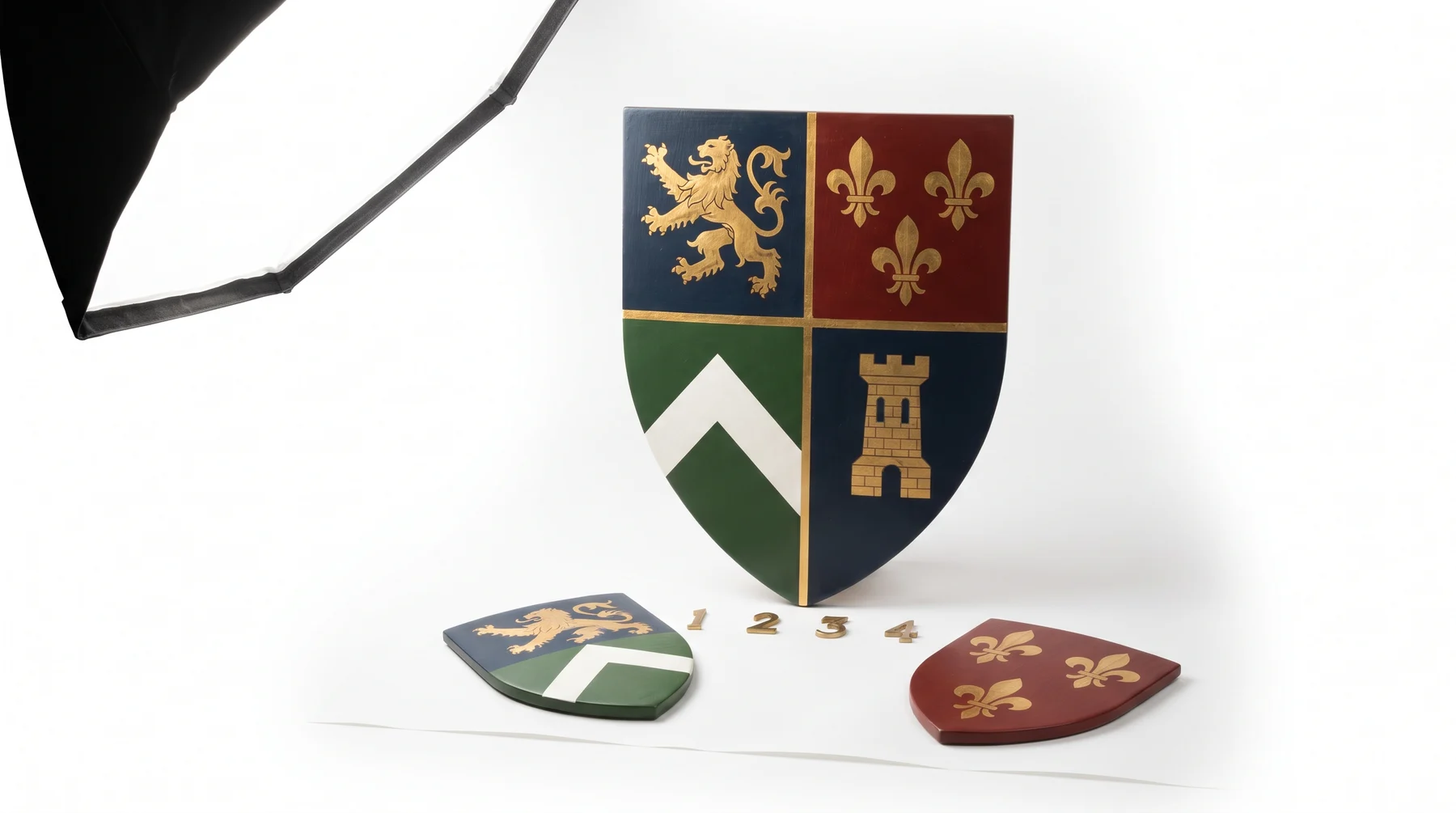
- Impalement — the shield split vertically, husband's arms in dexter, wife's in sinister. A marriage.
- Quartering — divided into four or more, each quarter a distinct family brought in through an heiress. The numbering runs left to right, top row first. A shield of sixteen quarterings is a pedigree drawn as a diagram.
- Escutcheon of pretence — a small shield in the centre, borne by a man whose wife was an heraldic heiress.
This is where a shield stops being decorative and starts being a document: every quarter is a claim that can be checked against a marriage record.
The Crest Is Not the Coat of Arms
The crest is the three-dimensional figure fixed to the top of the helmet — originally in boiled leather or light wood, and genuinely worn in tournaments. It usually rises from a wreath, sometimes from a coronet or a cap of maintenance.
Two things follow. First, the crest is a separate grant from the arms, and many arms have none at all. Second, "family crest" used to mean "the whole coat of arms" is a modern usage; a herald reading it strictly would take you to mean the figure on the helmet alone. Both usages are now common, and the distinction only matters where precision does — which, when you are trying to verify something, is exactly where it matters.
The coat of arms, and the crest
The shield itself
- What the blazon describes
- Granted or recorded as a whole
- Exists on its own, with nothing above it
- Worn on a helmet
The figure above the helm
- A separate grant from the arms
- Rises from a wreath, coronet or cap
- Present in every coat of arms
- The whole achievement, strictly speaking
Step 6: Read the Blazon
A blazon is the formal written description, and it is the authoritative form of a coat of arms — the painting is an interpretation of the blazon, not the other way round. Two artists may draw the same blazon in very different styles and both be correct.
The order is fixed:
- The field, with its division if any.
- The principal ordinary or charge, with its tincture.
- Secondary charges, with theirs.
- Marks of difference.
A tincture is rarely repeated where of the first or of the second can stand in, and punctuation is minimal by convention. So:
"Azure, a lion rampant Or" — a gold lion rearing on a blue field. Metal on colour: the rule holds.
"Gules, three fleurs-de-lis Argent, a chief engrailed Or" — red field, three white lilies, and a gold band across the top with a scalloped lower edge.
Write those out and you can reconstruct the shield without ever having seen it. That is the entire point of the system.
The order is fixed, and it never varies
AZURE, A LION RAMPANT OR
- The field
- Azure — blue
- Its division
- not recorded
- Principal charge
- A lion
- Its attitude
- Rampant — rearing
- Its tincture
- Or — gold
- Secondary charges
- not recorded
- Marks of difference
- not recorded
Reading the Motto
Mottoes are the least regulated part of an achievement. In England they form no part of the grant and can be changed at will; in Scotland the motto is recorded with the arms and cannot.
They fall into a few types: a declaration of faith or loyalty; a battle cry, which is what the earliest ones were; a statement of intent, such as the House of Orange's Je maintiendrai — "I will maintain"; and, satisfyingly often, a pun on the family name, matching a pun already made in the charges.
Practising on a Real Shield
Take any coat of arms and go through it in order: field, then division, then ordinary, then charges, then attitude, then marks of difference. Then ask the three questions that actually produce answers — does the charge pun on the name, does it look borrowed from another family's arms, is it the kind of element that had to be granted rather than assumed.
Then check the rule of tincture. If it breaks, either the drawing is a reproduction that lost its way, or you are looking at something with a story attached.
A coat of arms is not a picture. It is a sentence written in a vocabulary that has been stable for about eight hundred years.
Looking Up Your Own Surname
One caution worth stating plainly, because most sites do not. Arms in the European tradition were granted to or assumed by individuals, and inherited by their descendants — not by everyone who happens to share a surname. Armorials record arms borne by particular people and particular families. A surname is a way into that record, not a claim on it.
The Heritage Volume sets out what the historical record holds for a surname — the arms associated with it, blazoned in the order above, and where the name itself comes from. It is a documented account rather than a certificate of entitlement, and How Your Report Is Made explains exactly how it is assembled.
See the blazon drawn at full size in a framed coat of arms, or wear the crest on a signet ring.


