

Many are a stock design with a name printed on it.
This guide is about telling them apart — what a genuine heraldic record looks like, where to find it yourself for free, and what the honest limits of any surname-based product are, including ours.
What "Authentic" Means in Heraldry
It means something narrower than most people assume. A coat of arms is authentic when you can point to a named source, a named bearer, and a place and date. Not "the arms of the Murphy family" but "the arms recorded for John Murphy of Muskerry in Burke's General Armory, sourced from a specific visitation".
Three things follow from that definition, and each is a useful test.
- The blazon is the record, not the picture. A coat of arms exists as a written description. Two artists may paint the same blazon in very different styles and both be correct. A vendor who can show you the blazon has something; one who can only show you an image has a picture.
- Arms belong to people, not to names. Any product that offers one shield per surname is, at best, showing you one entry out of several and not saying so.
- The tradition has to match the name. Polish arms follow the clan herb system and look nothing like English ones. Scottish arms carry differencing marks as a matter of law. If a German surname arrives with a Scottish-looking clan badge, something has been assembled rather than found.
What is on record, and what is on sale
A recorded grant
- Has a written blazon
- Names a bearer and a place
- Can be looked up in an armorial
- Obeys the rule of tincture
A surname design
- Attached to a surname alone
- Comes with a blazon
- Names who bore it, or where
- Traceable to a granting authority
Seven Red Flags
1. No source is named
The most reliable single test. A genuine record cites where it came from: Burke's, Rietstap, Siebmacher, a visitation, a specific register and folio. "From our extensive archives" is not a source.
2. One shield per surname, with no mention of the others
Burke's lists dozens of distinct coats under common names. A source that hands you "the" Smith arms without noting that there are many is not describing the record accurately.
3. A crest exists for every single name
Crests were granted separately from arms, and plenty of armigerous families never had one. A catalogue with a crest for every surname is generating, not reporting.
4. Supporters on a family shield
In England and Scotland, supporters are restricted to peers, certain knights and corporate bodies. A private family achievement with two lions holding up the shield is almost always a printer's flourish.
5. The tincture rule is broken without explanation
Colour on colour, or metal on metal, is the one thing heraldry genuinely forbids. Deliberate exceptions exist and are famous — the arms of the Kingdom of Jerusalem, gold on silver. An unexplained breach in a family shield usually means the design was invented or the colours were garbled in reproduction.
6. A motto presented as ancient and fixed
In England the motto forms no part of the grant and can be changed at will. Only in Scotland is it recorded with the arms. A certificate treating a motto as an immutable family possession is overselling.
7. The word "official", anywhere
Only four or five bodies in the world can issue official arms, and none of them sells certificates through a website. Everything else is a reproduction — which is fine, as long as it says so.
The Sources You Can Check Yourself
Most of these are free, and several are fully digitised. If a vendor's claim is real, you can usually confirm it in twenty minutes.
Britain and Ireland
- Burke's General Armory (1884) — the standard published index of British and Irish arms by surname. Out of copyright and freely readable on the Internet Archive. This is the first place to look and the source most often quoted without attribution.
- Papworth's Ordinary of British Armorials — indexed the other way round: you look up a design and it tells you which families bore it. Invaluable when you have an image and no name.
- The Heralds' Visitations — county-by-county surveys made by officers of the College of Arms between about 1530 and 1688, recording who was entitled to what. Many are published by the Harleian Society and digitised.
- The College of Arms (London) — jurisdiction over England, Wales and Northern Ireland. Records are not public, but the College answers enquiries and searches are done by an officer for a fee.
- The Court of the Lord Lyon (Edinburgh) — the Public Register of All Arms and Bearings in Scotland has run continuously since 1672. Searches are available and Scottish arms are individually recorded to living people.
- The Office of the Chief Herald of Ireland, at the National Library of Ireland — grants and the surviving records of the old Ulster King of Arms.
Continental Europe
- Rietstap's Armorial Général — roughly 130,000 European families, blazoned in French. The standard first stop for any Continental name, and digitised.
- Siebmacher's Wappenbuch — the great German armorial, published in volumes from 1605 into the twentieth century, covering German, Austrian, Bohemian, Hungarian and Silesian arms.
- The Armorial Général de France (d'Hozier, 1696) — Louis XIV's registration, around 110,000 entries, digitised by the Bibliothèque nationale de France.
- Herbarz Polski and the Polish clan literature — for the herb system, where the shield belongs to a clan of many surnames.
- Regional and municipal armorials — often the richest source for a specific area, and usually held by the relevant national or provincial archive.
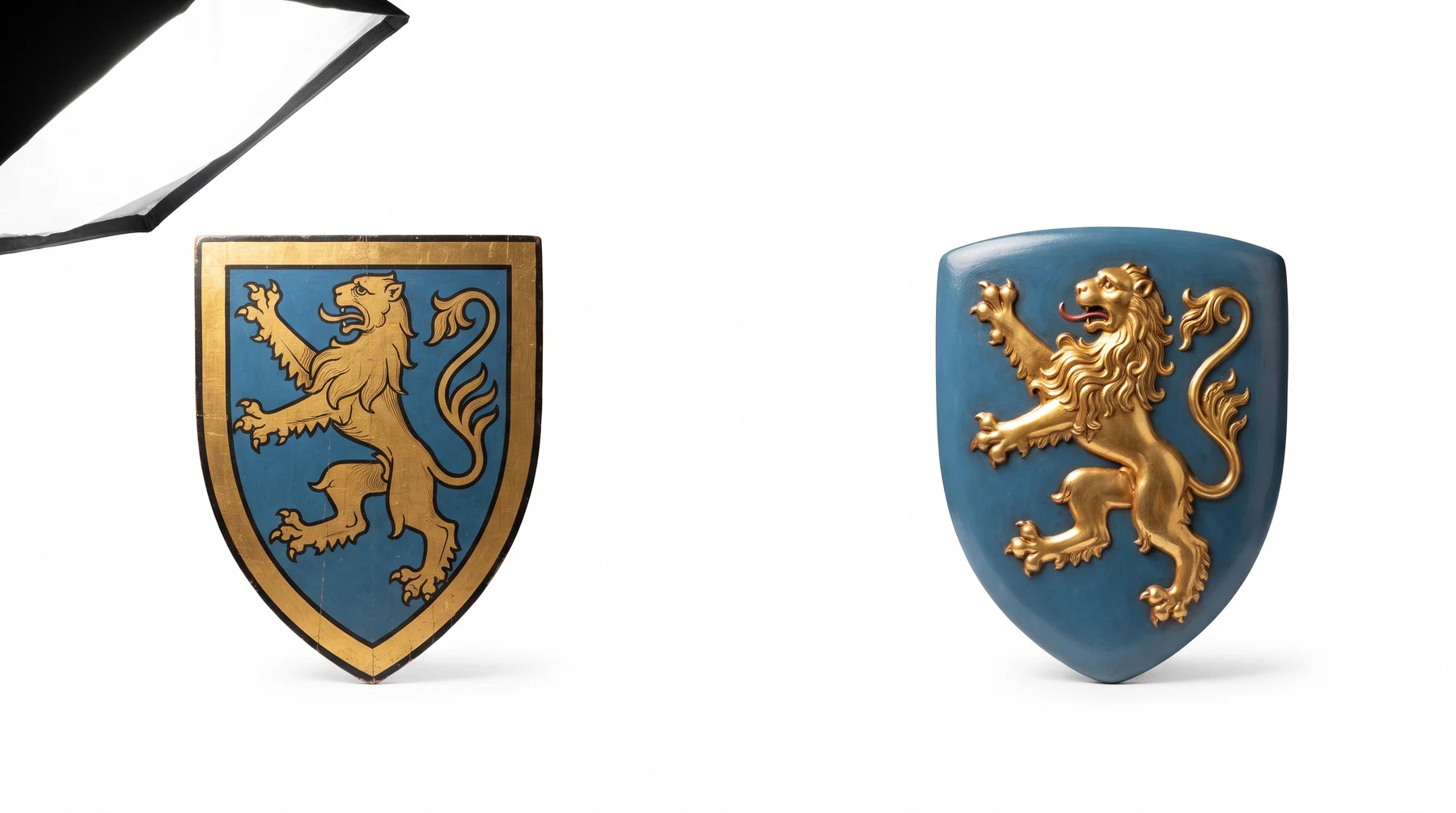
How to Run the Check, Step by Step
- Get the blazon. Ask the vendor for the written description. If they cannot produce one, stop here — there is no record behind the image.
- Look the surname up in Burke's or Rietstap depending on origin. Note how many entries exist and what distinguishes them: usually a place, sometimes a date of grant.
- Compare the blazons, not the pictures. Does the description you were given match one of the entries word for word, or approximately, or not at all?
- Check the rule of tincture on what you were sent. A breach suggests the image was redrawn by someone who did not know the rule.
- Locate the bearer. The entry will name a family and a place. Your own genealogy either reaches that place and family or it does not. This is the step that turns a surname into a claim, and it is the step nobody can do for you from a name alone.
Five steps, in this order
Get the blazon
Ask the vendor for the written description. If they cannot produce one, stop here: there is no record behind the image.
Look the surname up
In Burke’s or Rietstap, depending on origin. Note how many entries exist and what distinguishes them.
Compare the blazons
Not the pictures. Does the description match an entry word for word, approximately, or not at all?
Check the rule of tincture
A breach suggests the image was redrawn by someone who did not know the rule.
Locate the bearer
The entry names a family and a place. Your own genealogy either reaches them or it does not.
Being Straight About What We Do
It would be easy to end this article by implying we pass every test above. We would rather tell you exactly where we sit.
A Heritage Volume is a book about a surname, produced by a system we built. It is deterministic: the same surname always produces the same volume, for everyone who enters it. No one opens an archive on your behalf, and we never say otherwise.
Parts of it are genuine public record, shown with their source and a link you can follow: U.S. Census Bureau surname figures, digitised newspaper pages from the Library of Congress, documented people from open reference databases, and the etymology of the name.
Other parts are produced by our system rather than retrieved from a record — and that includes the coat of arms. The crest in a Heritage Volume is original artwork generated by artificial intelligence, built on heraldic visual grammar and tied deterministically to the surname. It is not a grant of arms, not a facsimile of an armorial entry, and not evidence of entitlement. By the tests set out earlier in this article, it is a representation rather than a record — and we would rather say so here than let you work it out afterwards.
All of that is set out in full, before you buy, on How Your Report Is Made — including a table stating, line by line, which parts are record and which are reconstruction. If a particular figure in a volume matters to you, you can write and ask which it is, and we will tell you.
The Bottom Line
If what you want is documented arms borne by a traceable ancestor, the route is the one above: the armorials, then the genealogy, then — if you want arms that are indisputably yours — a petition to the College of Arms, the Lord Lyon, the Chief Herald or the Canadian Heraldic Authority. It is slower and more expensive than a certificate, and it is the only thing that produces entitlement.
If what you want is a well-made object and a properly researched account of where a name comes from, that is a different thing and a legitimate one — as long as nobody dresses it up as the first.
The test to apply to any vendor, including us, is simple: do they tell you which is which before you pay?


