

Understanding what it was actually for explains almost everything odd about heraldry, including why it is so rigidly rule-bound and why it outlived the battlefield by eight hundred years.
The Problem It Was Invented to Solve
The dating is unusually precise for a medieval subject. Hereditary heraldry appears in western Europe in the middle of the twelfth century, and the earliest firmly dated evidence is an enamel plaque made around 1160 for the tomb of Geoffrey Plantagenet, Count of Anjou, who died in 1151. It shows him holding a blue shield with gold lions — and his grandson is recorded bearing the same device, which is what makes it heraldry rather than ornament.
What changed in that generation was the helmet. Twelfth-century knights wore mail, not plate — full plate armour is two hundred years later — but the open nasal helm was giving way to the enclosed great helm, which covered the whole face. A man in a great helm is anonymous, and anonymity on a field where ransom depended on recognising who you had captured was expensive as well as dangerous.
The solution was to paint a bold device on the shield, and repeat it on the linen surcoat worn over the mail — the coat of arms, from which the phrase comes.
Everything distinctive about heraldic design follows from that: flat colour, extreme contrast, few charges, strong silhouette. It had to be read across a field, quickly, by men who were frightened.
Why It Became Hereditary
A recognition device does not have to be inherited. Heraldry became so within about two generations, and the reason is land.
A twelfth-century lord's identity was a bundle of property rights, and those rights descended. The device that identified the man came to identify the holding — and then the family that held it. By around 1200 sons were bearing their fathers' arms as a matter of course, with small alterations to tell them apart, which is the point at which a battlefield convention becomes a system of inheritance.
The Seal: Heraldry's Real Day Job
This is the use most people underestimate, and it is the one that mattered most.
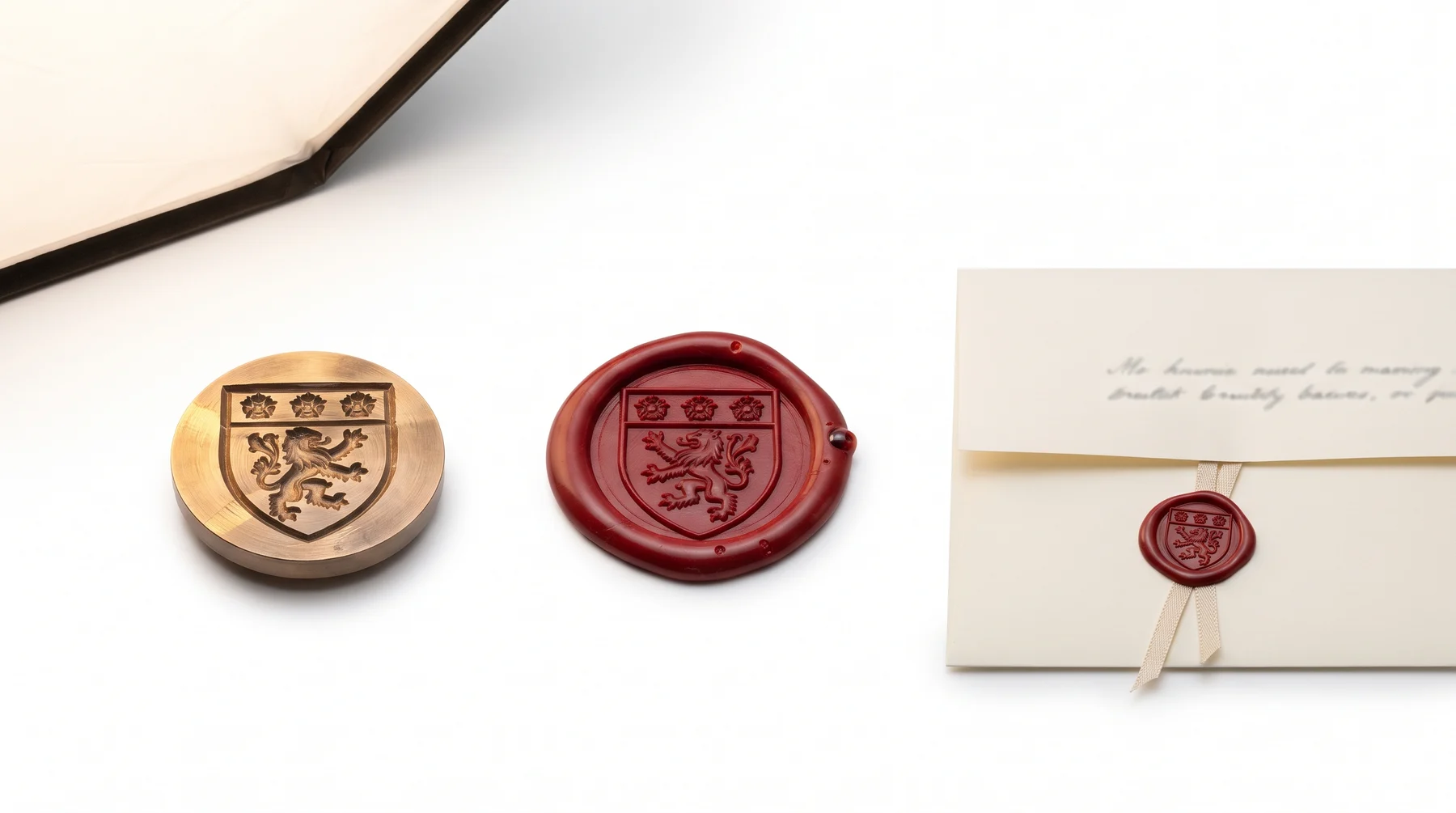
In a world where most landholders could not write, a document was authenticated by a seal: a design cut in reverse into a metal matrix, pressed into wax hanging from the parchment. Land grants, leases, wills, quitclaims, church endowments, treaties and letters all carried them, and the seal was legally the signature.
Armorial seals survive in colossal numbers — British and French archives hold hundreds of thousands — and they are the single largest body of evidence for medieval heraldry, far larger than the painted rolls. They are also the most reliable, because a seal is attached to a dated document naming the man who sealed it.
Three details worth knowing:
- A matrix was often destroyed or buried with its owner, precisely to prevent forgery after death.
- Women, towns, guilds, abbeys and universities all sealed, which is one of the clearest proofs that heraldry was never confined to knights.
- The signet ring is this function shrunk to something wearable, and it is why the crest — small, distinctive, legible at a quarter of an inch — became the element engraved on rings rather than the full shield.
Tournaments, and the Birth of the Herald
As the twelfth century turned into the thirteenth, the tournament grew from a rough mass mêlée into an organised spectacle, and heraldry became its apparatus. Arms were displayed on the shield, the surcoat, the banner, the horse's caparison and the tent outside the lists.
The men who ran this were the heralds. Their original job was announcement — they had to know every device present and to whom it belonged — and it made them, in effect, walking databases of who was who across Christendom. That expertise turned into three further roles: recording arms, adjudicating disputes about them, and carrying messages between commanders, for which heralds enjoyed a recognised immunity that made them the nearest thing the period had to diplomats.
The written product of that work is the roll of arms. The Matthew Paris shields of around 1244, the Dering Roll of about 1270 with its 324 shields of Kentish knights, and the great Zurich Roll of the 1340s are not decorative albums: they are reference works, compiled so that a herald could look an unfamiliar shield up.
When Two Families Claimed the Same Arms
The most revealing medieval heraldic document is a lawsuit.
In 1385, on campaign in Scotland, Sir Richard Scrope saw Sir Robert Grosvenor displaying Azure, a bend Or — the arms Scrope's family had borne for generations. Both men claimed them, and the case went to the Court of Chivalry, where it ran for five years and produced hundreds of depositions from witnesses who had seen the arms in use. One of the witnesses for Scrope was Geoffrey Chaucer, who testified about seeing the arms on campaign in France.
Richard II decided for Scrope in 1390. Grosvenor abandoned the bend and took Azure, a garb Or — a gold wheatsheaf on blue — which his descendants, the Dukes of Westminster, bear to this day.
Two things make this case worth knowing. It proves arms were legal property worth years of litigation, not ornament. And it shows the evidence that counted: not documents, but sworn testimony that people had seen the arms borne, in specific places, at specific dates.
In the Church: Heraldry as Permanent Record
Medieval churches are the best surviving heraldic archive above ground, because donation was recorded visually. A family that funded a chapel, glazed a window or endowed a chantry put its arms on the work — and the arms stayed when the family did not.
Look for them in four places: stained glass, often the oldest heraldry in a parish; monumental brasses and tomb effigies, where the arms date and identify the deceased; roof bosses and corbels, which frequently record who paid for the roof; and hatchments — the large diamond-shaped funeral panels hung outside a house after a death and later moved into the church, whose black-and-white background follows a code indicating whether the deceased was a husband, wife, widow or widower.
Marking Everything Else
Inside a household of any standing, arms were on the gates, the chimneypiece, the tapestries and bed-hangings, the plate, the bindings of books, the pottery, and the livery worn by servants and retainers. A retainer in his lord's livery badge was a walking statement of whose protection he had — which is exactly why the practice alarmed fifteenth-century English kings enough to legislate against it.
From Medieval Tool to Modern Institution
The apparatus did not disappear; it was formalised. The heralds became corporate bodies: the College of Arms in London in 1484, the Court of the Lord Lyon in Scotland, which still sits as a court of law under an act of 1672. Between about 1530 and 1688 English heralds carried out the visitations — county-by-county tours recording who was entitled to what and striking off those who were not. Those records are the backbone of British heraldic reference to this day.
Why the Record Is Worth Something
What survives from all this is unusually solid for medieval material: seals attached to dated deeds, rolls compiled by professionals, testimony given on oath, and stone and glass that has not moved in six hundred years. It records particular people, in particular places, on particular dates.
That is also its limit. It records those people — not everyone who later carried the same surname.
The Heritage Volume sets out what the historical record holds for a surname: where it comes from, where its bearers were concentrated, and the arms associated with it. How Your Report Is Made states exactly which parts come from public records and which our system builds.
To read a medieval shield yourself, start with our guide to reading a coat of arms.
The seal was the original use — a signet ring is still the closest thing to it.


