

The same table appears on hundreds of sites, always with the same wording, always without a source.
It is worth knowing where that table came from, because it changes how you read your own arms. The short version: the colours of a coat of arms are a real system with real rules, and the list of virtues attached to them is not part of it.
What the Tinctures Actually Are
The heraldic word for colour is tincture, and the system is deliberately small. A shield had to be identified across a tournament field, so heraldry uses a limited palette of strongly contrasting flat colours — no shading, no gradients, no in-between tones.
There are two metals, five colours, and a set of furs.
The Metals
- Or — gold, drawn as yellow. In engravings without colour it is shown as a field of dots.
- Argent — silver, drawn as white. In engravings it is left plain.
Metals are the light tinctures. They are what the colours sit on, and what sits on the colours.
The Colours
- Gules — red. The most common tincture in European arms. From the Old French gueules.
- Azure — blue.
- Sable — black.
- Vert — green. In older English usage sometimes called sinople, the word still used in French heraldry.
- Purpure — purple. Genuinely uncommon, and the reason is not what you usually read: arms are painted, not dyed, so the cost of Tyrian purple has nothing to do with it. Purpure is simply harder to distinguish from gules and azure at a distance, which defeats the purpose.
Two further tinctures, the stains — murrey (mulberry) and tenné (orange-tawny) — appear rarely and mostly in later heraldry.
Nine tinctures, and what each one is called
- OrGold, drawn as yellow
- ArgentSilver, drawn as white
- GulesRed
- AzureBlue
- SableBlack
- VertGreen
- PurpurePurple, uncommon
- MurreyMulberry, a stain
- TennéOrange-tawny, a stain
The One Real Rule
Heraldry has a single governing convention about colour, and it is the thing worth learning:
Metal is not placed on metal, and colour is not placed on colour.
A gold lion goes on a red field. A red lion goes on a gold field. A red lion does not go on a blue field, and a gold cross does not go on a silver one.
The reason is visibility. Two colours of similar tonal value blur into each other at distance and in poor light, and a device that cannot be read at distance is useless. The rule is not about taste. It is engineering.
What makes it interesting is the exceptions. Arms that deliberately break it are called armes à enquérir — arms to be enquired into — because the breach is a signal that there is a story. The most famous is the Kingdom of Jerusalem: a gold cross potent between four gold crosslets, on silver. Metal on metal, in the most conspicuous possible way, and no herald has ever considered it an error.
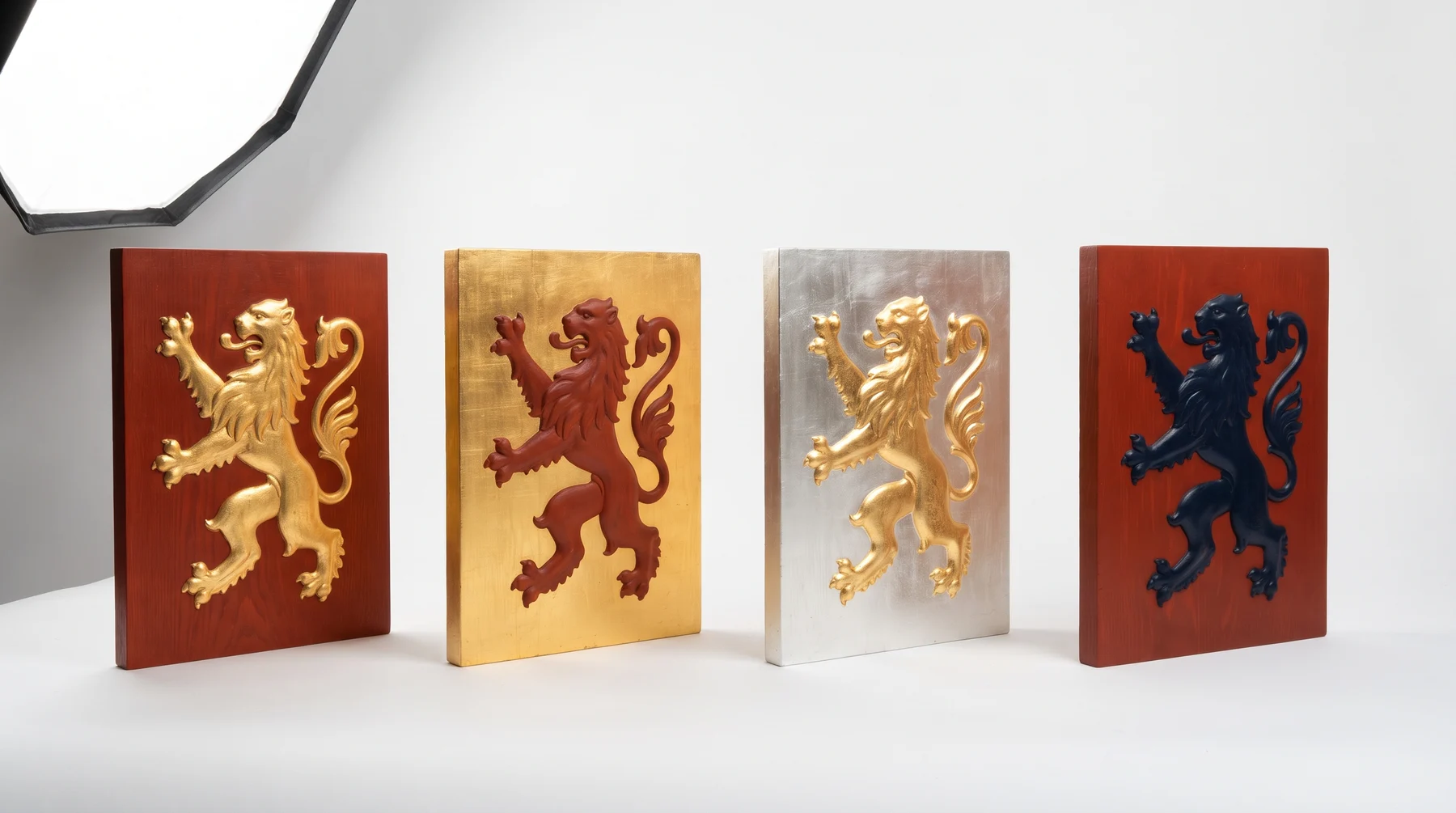
Metal is not placed on metal, and colour is not placed on colour.
The Furs
Furs are patterned tinctures that stand outside the metal-and-colour rule: a fur may be placed on either.
- Ermine — white with black tails, representing the winter coat of the stoat. Its variants are worth knowing because they are commonly misread: ermines (also called counter-ermine) is black with white tails, erminois is gold with black tails, and pean is black with gold tails.
- Vair — an interlocking pattern of blue and white shapes, representing squirrel pelts sewn back to back. Its variants include counter-vair, vair-en-point, and the larger-shaped potent and counter-potent.
So Where Did the Table of Meanings Come From?
It came from books, and we can date them.
From the late sixteenth century a fashion developed among heraldic writers for mapping the tinctures onto other systems — the planets, the precious stones, the ages of man, the virtues. Or was the sun, and topaz, and generosity. Argent was the moon, and pearl, and sincerity. Gules was Mars, and ruby, and martial courage. The most influential English version appears in John Guillim's A Display of Heraldrie of 1611, a book that was reprinted for a century and is the direct ancestor of every colour-meaning table online today.
It was a literary conceit, not a working part of heraldry, and heralds said so. A. C. Fox-Davies, whose A Complete Guide to Heraldry (1909) is still the standard English reference, dismissed the symbolism of colours as "absolutely and entirely fiction". No grant of arms has ever been made on the basis of what a tincture is supposed to signify, and no herald designing arms today consults such a list.
This matters practically. If someone tells you your family's red and gold shield proves your ancestors were wealthy warriors, they are reading a table from 1611 and presenting it as evidence about your family. It is not evidence about anything.
What the Colours Do Tell You
Quite a lot, in fact — just not about virtue.
Region and period
Heraldic palettes vary by tradition. Gules and Or dominate Spanish and southern French arms. Sable is markedly more common in German arms than in English ones. Vert is rare in medieval English heraldry and much more frequent in nineteenth-century grants. A shield's palette is a rough fingerprint of where and when it was designed.
Livery and allegiance
The colours a family put on its servants' coats — its livery — were usually the principal metal and colour of its arms, and those colours became a visible statement of whose household you belonged to. Borrowed tinctures often signal a relationship: a marriage, a feudal tie, a grant from a patron.
Differencing
Within one family, a change of tincture is one of the standard ways to distinguish the arms of a branch from those of the senior line.
Canting
Occasionally the colour is the pun. The Italian family Rossi bearing red, the Blackwood family bearing sable — heraldry's oldest habit is making the arms sound like the name.
How to Describe Your Arms Properly
A blazon — the formal description — has a fixed order, and once you know it you can read any shield in any European language.
- The field first: its tincture, or how it is divided.
- The principal charge, with its tincture.
- Any secondary charges, with theirs.
- Marks of difference, last.
So Azure, a lion rampant Or is a gold lion standing on a blue field — and because it is metal on colour, it obeys the rule. You now know enough to check that yourself on any coat of arms you meet.
Reading Your Family's Colours
What the tinctures on your family's arms record is a set of design decisions made in a particular place and century, under a rule about contrast that has held for eight hundred years. That is a real and interesting thing to inherit. It is not a personality test, and anyone selling it as one is quoting a Jacobean bestseller without saying so.
The Heritage Volume names the tinctures of the arms associated with your surname and blazons them properly, in the order above. What it does not do is tell you that gold means your ancestors were generous. Our full method is set out in How Your Report Is Made.
See the tinctures at full resolution with a framed coat of arms.


